What is Content Management System (CMS) and How It Works?

With the increasing demand for website development services, we need to be aware about the CMS functionalities and features so that we can get a strong website for our business. First, we need to understand that What is Content Management System (CMS). CMS is a software application, or you can say a set of related programs that are used to create and manage digital content. Typically, CMSes are used to manage the website content and enterprise content management. CMS works like a tool to create a website without writing scratch. So, it does not require high technical skills to develop a website.

What are the Popular Content Management Systems?

WordPress is one of the trending best example of a popular content management system. Although there are lots of other content management systems in existence. WordPress covers over a 35.2% market share on websites with a reputed CMS.

WordPress.org is the actual place where you can find out the actual open-source WordPress CMS. Its interface is very user-friendly and easy to maintain.

Apart from WordPress there are lots of CMS available in the market are listed below-:

  • Joomla
  • Drupal
  • Magento (for eCommerce stores)
  • Squarespace
  • Wix
  • TYPO3

So, Above are the popular CMSes which are available in the market.

Types of websites we can develop with these CMS

  1. Static Websites
  2. Blogs
  3. eCommerce Portals and Stores
  4. Forums
  5. Social networking websites
  6. Online courses
  7. Membership sites
  8. Portfolios

Steps to build a website using a CMS

Developing a website using a content management system is very easy. You need to follow some steps only.

  1. Purchase a domain name and web hosting from any hosting provider.
  2. Install your CMS on your web server.
  3. Theme Management: Configure CMS to dictate how your site looks and functions
  4. Start editing your favorite theme and get complete your WordPress website.

So, these above are the basic steps by which you can develop your website.

You Can Also Check our SEO services for Different Cities:

SEO Company Noida

SEO Company Delhi

SEO Company Gurgaon

Complete Guide to Neo4j in 2020

What is Neo4j?

Neo4j is an open source, NoSQL and native graph database which provides an ACID-compliant transactional backend for your applications. If we talk about the origin of Neo4j, then its development was started in 2003 but it was available for use in 2007. Its source code was written in JAVA and Scala languages. It was free of cost available in on GitHub or as a user-friendly desktop application download. Neo4j has 2 editions i.e. community edition and enterprise edition. Enterprise Edition is an upgraded version of community version with the extra enterprise requirements such as backups, clustering, and failover abilities.

As it efficiently implements the property graph model down to the storage level, it is known as native graph database. Data is stored exactly as you whiteboard it, and the database uses pointers to navigate and traverse the graph. In contrast to graph processing or in-memory libraries, Neo4j also provides full database characteristics, including ACID transaction compliance, cluster support, and runtime failover – making it suitable to use graphs for data in production scenarios.

Top features of Neo4j which makes it popular among developers, architects, and DBAs:

  1. Cypher: It is a query language like SQL, but it is especially optimized for the graph. Now it is used by other databases SAP HANA Graph and Redis graph via the openCypher project.
  2. Constant time traversals: Constant time traversals in big graphs for both depth and breadth due to efficient representation of nodes and relationships. Enables scale-up to billions of nodes on moderate hardware.
  3. Flexible Property Graph Schema: It can adapt over time, makes it possible to materialize and new relationships later to shortcut and speed up the domain data according to the business needs.
  4. Drivers: It has drivers for popular programming languages including Java, JavaScript, .NET, Python, and many more.

Neo4j Use Cases:

Now a days Neo4j is used by thousands of companies and organizations in almost all the industries, including financial services, government, energy, technology, retail, and manufacturing.

To know more about Neo4j You can consult with our software development team.

You can also Check our SEO Services in Delhi

What is The Role of Containers in Speed Up Cloud and Mobile Application Development?

Technology has changed the way of doing business by providing fast and easiest methods to customer interaction.  Almost all business modules are enabled with the technology applications. Which has rapidly changed the mobile application development future. Customer expects to reach your business using whatever the way they feel comfortable. So, the all your business success depends on the speed which can be created by your mobile app developers by implementing containerized application development.

Container is one of the most popular technologies used to enhance productivity and speed of an application. Let’s understand the containers.

What Are Containers?

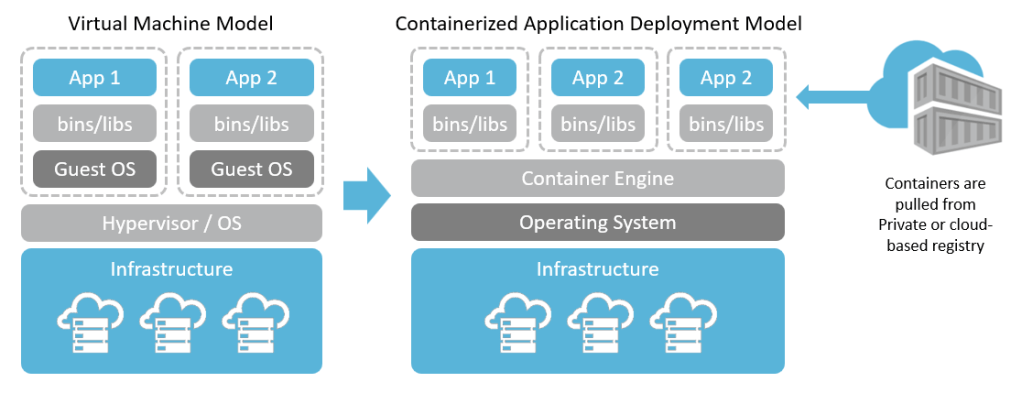
Containers are the technology which offer a logical packaging mechanism in which applications can be abstracted from the environment in which they run in real time This isolation and abstraction technology to isolate all the required application files from the runtime environment. It allows applications to run faster and easier between different environments such as testing, development and production etc. These kinds of applications are more light weighted rather than traditional methodologies.

For more details You can visit: https://cloud.google.com/containers/

Main features of Containers Which Makes It So Popular:

  1. Digital transformation
  2. Multi-cloud
  3. Open source
  4. DevOps

Main benefits of Containers:

Consistent Environment: Containers allows the developers to desired environment which are isolated from other applications. It can also include the software dependencies which are needed to run the application like specific of programming language versions, and other software libraries. It ultimately helps to developers to deploy the application without concerning the environment. So, in this way it saves the developers and IT team’s time to deploy, test or debug the mobile and cloud application in the different environment.

Run Anywhere: Containers has the capability to run virtually anywhere and it is damn easy id developing and deploying on windows, Linux, MAC operating system, on virtual machines and in public cloud.

Isolation: It virtualize network resources, CPU, memory, and storage at the Operating system-level, providing programmers with a sandboxed view of the OS logically isolated from other applications.

Management and Orchestration with Kubernetes are implemented with Kubernetes

When an enterprise needs to manage containers at large scale then, they need a robust container orchestration and management technology. So, Kubernetes is an open source orchestration system that is used to manage containerized applications in distributed clusters.

Design a site like this with WordPress.com
Get started